← Training SplitsView exerciseView exerciseView exerciseView exerciseView exerciseView exerciseView exercise View exerciseView exerciseView exerciseView exerciseView exerciseView exerciseView exerciseView exerciseView exercise View exerciseView exerciseView exerciseView exerciseView exerciseView exerciseView exercise
Advanced
Arnold Split
Antagonist pairings — chest with back, shoulders with arms — for an intense pump and old-school size. Six days for advanced lifters.
Goal
Old-school size via antagonist supersets — high volume for advanced lifters.
- 6
- Days / week
- 23
- Exercises
- 79
- Total sets
- ~85 min
- Session time
Periodization
The mesocycle
PhaseWeeksIntensityRIRFocus
PhaseAdaptationWeeksWeek 1Intensity65–72% 1RMRIR3–4 RIRFocusGroove technique, full range, low end of the set range.
PhaseAccumulationWeeksWeeks 2–3Intensity70–78% 1RMRIR2 RIRFocusAdd a set or reps each week — drive weekly volume up.
PhaseIntensificationWeeksWeek 4Intensity80–85% 1RMRIR1 RIRFocusTop of the load range on the compounds, push close to failure.
PhaseDeloadWeeksWeek 5Intensity−10% loadRIR4+ RIRFocusVolume −40%, half the sets — recover and resensitise.
How to run it
When do you level up?
Level-up rule: run a column until you own EVERY top-of-range set at its loads for two consecutive weeks — then the next column is yours. Junior ≈ your first month, Intermediate ≈ month 3, Advanced ≈ month 6. Your bodyweight will change on the way; the loads don’t care — re-calibrate after every deload week and let the working weights, not the scale, decide the column.
Volume check
Weekly muscle coverage
Direct hard sets per muscle group per week — synergists not counted (pressing also works the triceps, pulling the biceps). 10–20 hard sets is the growth zone: below is maintenance, above demands elite recovery.
MuscleHard sets / weekFrequency
Chest242× / week
Lats162× / week
Upper back & traps82× / week
Shoulders262× / week
Biceps122× / week
Triceps122× / week
Quads162× / week
Hamstrings142× / week
Glutes62× / week
Calves62× / week
Core186× / week
How to run it
How to run it
Find your weight
Don't max out to find your numbers. (1) Warm up, then load the reference weight for your level. (2) Do one set: if you finish the top of the rep range with MORE than the target RIR left, add 2.5 kg (upper) / 5 kg (lower) and repeat; if you can't reach the bottom of the range at the target RIR, take the same off. (3) That weight is your working load for every set that day. Junior: start one notch BELOW the reference and earn the jumps — clean reps beat heavy reps.
How to run it
Superset antagonist pairs (chest/back) to save time and flood the area with blood. High volume — only run this with years of training and solid recovery behind you. The core finisher recovers fast — you can also run it daily or on rest days; obliques count.
Progression
+2.5 kg on presses/rows when every set hits the top rep target; micro-load isolations.
Warm-up
General: 5 min easy cardio + dynamic mobility for the day's joints. Per heavy compound, ramp: 10 reps empty bar → 5 @ 50% → 3 @ 70% → 1 @ 85% of your working weight. Isolation: one light feeder set.
Autoregulation (RPE/RIR)
RIR = reps in reserve (left in the tank); RPE 8 = 2 RIR. Pick a load that lands you on the target RIR at the last rep — feel strong, add weight; feel flat, take some off. Anchor every working weight to YOUR own 1RM, not the reference numbers.
Cardio
Volume here is enormous — cap cardio at 2 × 20 min easy spins in the rest windows. More would eat the recovery this split lives on. 6–8k daily steps cover the rest.
Deload
Every 5th–6th week: volume −40%, intensity −10%, every set left at 4+ RIR. One light week resets fatigue before the next mesocycle.
Weekly schedule
Mon Chest+Back · Tue Shoulders+Arms · Wed Legs · repeat Thu–Sat · Sun rest
The workout
Training days
Working weights are guidelines for a reference athlete. Anchor them to your own 1RM and hit the target RPE — the prescription is the %1RM, the reps and the RIR, not the kilos.
What do %1RM, RPE, RIR and Tempo mean?
The prescription in plain words
Every exercise carries a few numbers. Here's how to read them — no jargon.
- Same weight for every set
- Yes: after your warm-up sets, use the same weight for all working sets of an exercise — whether it's two sets or three. Fatigue builds up, so the last set is the hardest, and that's where you check the RIR target. You raise the weight next week or next phase, never between sets.
- Sets × reps
- "3 × 8–10" means 8 to 10 reps back to back, then rest — three times over. One such round is a set.
- %1RM — your working weight
- %1RM is the share of the weight you could lift exactly once. You never have to test that: take the working weight shown for your level as a starting point and adjust after your first set.
- RPE & RIR — how hard it should feel
- RIR means "reps in reserve" — how many reps you'd still have left at the end. "3 RIR" means stop when you could still do about 3 clean reps. RPE is the same idea inverted (RPE 7 ≈ 3 in reserve). Never train to full failure.
- Tempo — how fast you move
- Three numbers for the seconds per phase: lower – pause – lift. "3-1-1" means lower under control for 3 s, hold 1 s, lift 1 s. Slow lowering builds the most muscle.
Reference loads assume an ~80–90 kg male. Lighter or female athletes typically scale to ~60–70% of the upper-body numbers and ~70–80% of the lower-body numbers — the %1RM, reps and RIR stay identical.
Training phase
Working weight by level
Day 12× / week
Chest & Back
Pectorals · Lats · Upper Back · Core
7
Exercises
27
Sets
~90
min
Warm-up~10 minLifting~72 minCool-down & stretching~6 minChest12Lats8Upper back & traps4Core3
Coach's note
Alternate a press and a row/pulldown as supersets — chest and back in the same session.
Time-saver
Run it as Arnold did — antagonist supersets: barbell bench + cable pulldown, dumbbell press + assisted pull-up, cable press + bent-over row. One set of each back-to-back, rest 90 s after the pair — the pump doubles and the session drops by ~12 min.
Second session this week
Second run (Thu): bench → incline bench, cable press → assisted chest dip, and pull from a low-cable angle. Arnold rotated angles relentlessly — same superset pairs, new stimulus.
%1RM77–82%RPE6 · 4 RIRTempo3-1-1Rest2–3 minmin~13
Jun40 kgInt72.5 kgAdv102.5 kg
Shoulder blades pinned, bar to lower chest, drive through mid-foot.
Machine taken or not in your gym?
Warm-up sets
15 × 37.5 kg8 × 55 kg
Step by step
- Lie flat on a bench with your feet flat on the ground and your back pressed against the bench.
- Grasp the barbell with an overhand grip slightly wider than shoulder-width apart.
- Lift the barbell off the rack and hold it directly above your chest with your arms fully extended.
- Lower the barbell slowly towards your chest, keeping your elbows tucked in.
- Pause for a moment when the barbell touches your chest.
- Push the barbell back up to the starting position by extending your arms.
- Repeat for the desired number of repetitions.
%1RM73–78%RPE6 · 4 RIRTempo3-0-1Rest90–120 smin~10
Jun14 kgInt22.5 kgAdv35 kg
Per dumbbell. Stretch deep at the bottom, press in a slight arc.
Machine taken or not in your gym?
Warm-up sets
15 × 12 kg8 × 16 kg
Step by step
- Lie flat on a bench with your feet flat on the ground and your back pressed against the bench.
- Hold a dumbbell in each hand, with your palms facing forward and your arms extended above your chest.
- Lower the dumbbells slowly to the sides of your chest, keeping your elbows at a 90-degree angle.
- Pause for a moment, then push the dumbbells back up to the starting position, fully extending your arms.
- Repeat for the desired number of repetitions.
%1RM73–78%RPE6 · 4 RIRTempo3-0-1Rest90–120 smin~10
Jun20 kgInt35 kgAdv50 kg
Cable stack. Constant tension — never lock out fully.
Machine taken or not in your gym?
Warm-up sets
15 × 17.5 kg8 × 27.5 kg
Step by step
- Adjust the cable machine to chest height and attach the handles.
- Stand facing away from the machine with your feet shoulder-width apart.
- Grasp the handles with an overhand grip and step forward to create tension in the cables.
- Position your feet firmly on the ground and engage your core.
- Bend your elbows and bring your hands to shoulder level, keeping your elbows at a 90-degree angle.
- Push the handles forward, extending your arms fully in front of you.
- Pause for a moment, then slowly reverse the movement, bringing your hands back to shoulder level.
- Repeat for the desired number of repetitions.
%1RM73–78%RPE6 · 4 RIRTempo3-0-1Rest90–120 smin~10
Jun27.5 kgInt45 kgAdv65 kg
Cable stack. Drive elbows to hips, squeeze the lats, control up.
Machine taken or not in your gym?
Warm-up sets
15 × 22.5 kg8 × 35 kg
Step by step
- Sit on the cable machine with your back straight and feet flat on the ground.
- Grasp the handles with an overhand grip, slightly wider than shoulder-width apart.
- Lean back slightly and pull the handles towards your chest, squeezing your shoulder blades together.
- Pause for a moment at the peak of the movement, then slowly release the handles back to the starting position.
- Repeat for the desired number of repetitions.
%1RM73–78%RPE6 · 4 RIRTempo3-0-1Rest90–120 smin~10
Jun45 kgInt25 kgAdv10 kg
Assist weight — LESS assistance is harder. Set assist so the last 1–2 reps are hard. Full hang to chin-over-bar.
Machine taken or not in your gym?
Warm-up sets
15 × 37.5 kg8 × 32.5 kg
Step by step
- Adjust the machine to your desired weight and height.
- Place your hands on the parallel bars with a close grip, palms facing each other.
- Hang from the bars with your arms fully extended and your feet off the ground.
- Engage your back muscles and pull your body up towards the bars, keeping your elbows close to your body.
- Continue pulling until your chin is above the bars.
- Pause for a moment at the top, then slowly lower your body back down to the starting position.
- Repeat for the desired number of repetitions.
%1RM73–78%RPE6 · 4 RIRTempo3-0-1Rest90–120 smin~10
Jun35 kgInt60 kgAdv87.5 kg
Torso ~45°, pull to the navel, no jerking the weight up.
Machine taken or not in your gym?
Warm-up sets
15 × 30 kg8 × 45 kg
Step by step
- Stand with your feet shoulder-width apart and knees slightly bent.
- Bend forward at the hips while keeping your back straight and chest up.
- Grasp the barbell with an overhand grip, hands slightly wider than shoulder-width apart.
- Pull the barbell towards your lower chest by retracting your shoulder blades and squeezing your back muscles.
- Pause for a moment at the top, then slowly lower the barbell back to the starting position.
- Repeat for the desired number of repetitions.
%1RM—RPE6 · 4 RIRTempo2-0-1Rest45–60 smin~6
JunBodyweightIntBodyweightAdvBodyweight
Bodyweight. No swing — raise the legs with the abs, lower slow, control the return.
Machine taken or not in your gym?
Step by step
- Hang from a pull-up bar with your arms fully extended and your palms facing away from you.
- Engage your core and lift your legs up in front of you, keeping them straight.
- Continue lifting until your legs are parallel to the ground or as high as you can comfortably go.
- Pause for a moment at the top, then slowly lower your legs back down to the starting position.
- Repeat for the desired number of repetitions.
Cool-down & stretching
~6 minChest and back trained against each other all session — so stretch them against each other too: open the front, lengthen the lat, then rotate the spine free.
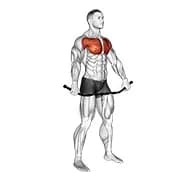
Clasp your hands behind your back, lift the sternum and pull the shoulders back and down. Don't arch the lower back — the stretch belongs in the chest, not the lumbar spine.
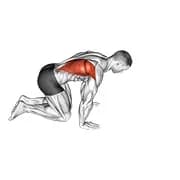 kneeling lat stretch2× 30 s per side
From all fours walk the hands forward, hips back toward the heels, sternum to the floor. Breathe into the flank — the lat only releases on the exhale.
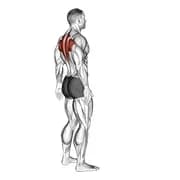 upper back stretch1× 30 s
Interlace the fingers, press the arms forward and deliberately round the upper back to spread the shoulder blades. The exact counter-move to every row.
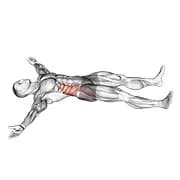 iron cross stretch1× 30 s per side
On your back, arms in a T, lower the legs to one side under control. Both shoulder blades stay on the floor — the rotation comes from the thoracic spine, not the lower back.
Static stretching belongs AFTER the session, never before it — held before a heavy set it measurably costs force output. Move into each position until you feel mild tension, never pain, and breathe out into it. Hold still: no bouncing on a fatigued muscle. Skip a muscle that is cramping and walk it off first.
Day 22× / week
Shoulders & Arms
Delts · Biceps · Triceps · Core
9
Exercises
28
Sets
~80
min
Warm-up~10 minLifting~62 minCool-down & stretching~7 minShoulders13Biceps6Triceps6Core3
Coach's note
Press overhead first, then superset biceps and triceps for a massive arm pump.
Time-saver
Pair biceps with triceps, Arnold-style: dumbbell curl + overhead rope extension, rope curl + close-grip bench. One set of each back-to-back, rest 60–90 s after the pair — saves ~8 min. Keep the overhead press straight sets; it's the day's primary.
Second session this week
Second run (Fri): barbell overhead press → seated dumbbell press, dumbbell curls → preacher curls. The joints get a new path while the volume stays brutal.
%1RM77–82%RPE6 · 4 RIRTempo3-1-1Rest2–3 minmin~13
Jun25 kgInt42.5 kgAdv62.5 kg
Seated, braced, press straight up — ribs down, full lockout, no lean-back.
Machine taken or not in your gym?
Warm-up sets
15 × 22.5 kg8 × 32.5 kg
Step by step
- Sit on a bench with your back straight and feet flat on the ground.
- Hold the barbell with an overhand grip, slightly wider than shoulder-width apart.
- Lift the barbell off the rack and bring it to shoulder level, with your elbows bent and palms facing forward.
- Press the barbell overhead by extending your arms fully.
- Pause for a moment at the top, then slowly lower the barbell back to shoulder level.
- Repeat for the desired number of repetitions.
%1RM63–68%RPE6 · 4 RIRTempo2-0-1Rest60 smin~6
Jun7 kgInt12 kgAdv17.5 kg
Per dumbbell. Press straight up, ribs down, full lockout.
Machine taken or not in your gym?
Warm-up sets
15 × 6 kg8 × 10 kg
Step by step
- Stand with your feet shoulder-width apart and hold a dumbbell in one hand at shoulder level, palm facing forward.
- Engage your core and press the dumbbell straight up overhead, fully extending your arm.
- Pause for a moment at the top, then slowly lower the dumbbell back to shoulder level.
- Repeat for the desired number of repetitions, then switch to the other arm.
%1RM63–68%RPE6 · 4 RIRTempo2-0-1Rest60 smin~6
Jun6 kgInt10 kgAdv14 kg
Per dumbbell. Lead with the elbows to shoulder height, soft bend, no swinging.
Machine taken or not in your gym?
Warm-up sets
12 × 6 kg
Step by step
- Stand with your feet shoulder-width apart and hold a dumbbell in each hand, palms facing your body.
- Keep your back straight and engage your core.
- Raise your arms out to the sides until they are parallel to the floor, keeping a slight bend in your elbows.
- Pause for a moment at the top, then slowly lower your arms back down to the starting position.
- Repeat for the desired number of repetitions.
%1RM63–68%RPE6 · 4 RIRTempo2-1-1Rest60 smin~7
Jun5 kgInt9 kgAdv15 kg
Per dumbbell. No swing, supinate as you curl, lower under control.
Machine taken or not in your gym?
Warm-up sets
12 × 6 kg
Step by step
- Stand up straight with a dumbbell in each hand, palms facing forward and arms fully extended.
- Keeping your upper arms stationary, exhale and curl the weights while contracting your biceps.
- Continue to raise the weights until your biceps are fully contracted and the dumbbells are at shoulder level.
- Hold the contracted position for a brief pause as you squeeze your biceps.
- Inhale and slowly begin to lower the dumbbells back to the starting position.
- Repeat for the desired number of repetitions.
%1RM63–68%RPE6 · 4 RIRTempo2-1-1Rest60 smin~7
Jun12.5 kgInt22.5 kgAdv32.5 kg
Cable stack, rope. Neutral grip, elbows pinned, curl to a hard squeeze — hammers thicken the brachialis under the biceps.
Machine taken or not in your gym?
Warm-up sets
12 × 12.5 kg
Step by step
- Stand upright with your feet shoulder-width apart and a slight bend in your knees.
- Hold the cable rope attachment with an underhand grip, palms facing each other, and your arms fully extended.
- Keeping your upper arms stationary, exhale and curl the weights while contracting your biceps.
- Continue to raise the cable rope attachment until your biceps are fully contracted and the rope is at shoulder level.
- Hold the contracted position for a brief pause as you squeeze your biceps.
- Inhale and slowly begin to lower the cable rope attachment back to the starting position.
- Repeat for the desired number of repetitions.
%1RM63–68%RPE6 · 4 RIRTempo2-0-1Rest60 smin~6
Jun25 kgInt45 kgAdv65 kg
Elbows tucked ~45°, bar to lower sternum — triceps-led press.
Machine taken or not in your gym?
Warm-up sets
15 × 22.5 kg8 × 35 kg
Step by step
- Lie flat on a bench with your feet flat on the ground and your back pressed against the bench.
- Grasp the barbell with a close grip, slightly narrower than shoulder-width apart.
- Unrack the barbell and lower it slowly towards your chest, keeping your elbows close to your body.
- Pause for a moment when the barbell touches your chest.
- Push the barbell back up to the starting position, fully extending your arms.
- Repeat for the desired number of repetitions.
%1RM63–68%RPE6 · 4 RIRTempo2-0-1Rest60 smin~6
Jun20 kgInt35 kgAdv50 kg
Cable stack, rope overhead. Elbows narrow and high, extend to a full lockout — the overhead angle that grows the long head.
Machine taken or not in your gym?
Warm-up sets
12 × 20 kg
Step by step
- Attach a rope to a cable machine at a high position.
- Stand facing away from the machine with your feet shoulder-width apart.
- Grasp the rope with both hands, palms facing each other, and bring your hands above your head.
- Keep your upper arms close to your head and your elbows pointing forward.
- Slowly lower the rope behind your head by bending your elbows.
- Pause for a moment, then extend your arms back up to the starting position.
- Repeat for the desired number of repetitions.
%1RM63–68%RPE6 · 4 RIRTempo2-0-1Rest60 smin~6
Jun7.5 kgInt12.5 kgAdv17.5 kg
Sit strict, lead the cables out with the pinkies in a wide arc — rear delts move it, keep the traps quiet.
Machine taken or not in your gym?
Warm-up sets
12 × 7.5 kg
Step by step
- Sit on a bench facing the cable machine with your feet flat on the ground.
- Grasp the cable handles with an overhand grip and extend your arms straight in front of you.
- Keeping your arms straight, slowly raise them out to the sides until they are parallel to the floor.
- Pause for a moment at the top, then slowly lower your arms back to the starting position.
- Repeat for the desired number of repetitions.
%1RM63–68%RPE6 · 4 RIRTempo2-0-1Rest45–60 smin~6
Jun10 kgInt20 kgAdv30 kg
Curl the pelvis up against the cable, abs do the work — don't yank from the hip flexors.
Machine taken or not in your gym?
Warm-up sets
12 × 12.5 kg
Step by step
- Attach a cable to a low pulley and lie down facing up on a mat.
- Hold the cable with both hands and extend your arms straight up towards the ceiling.
- Bend your knees and lift your legs up, bringing your thighs towards your chest.
- While keeping your upper body stable, curl your pelvis up towards your chest, lifting your hips off the mat.
- Pause for a moment at the top, then slowly lower your hips back down to the starting position.
- Repeat for the desired number of repetitions.
Cool-down & stretching
~7 minDelts and arms in one session means the shoulder capsule and both elbows. Rear delt and triceps get the rounds; neck and forearms get one each.
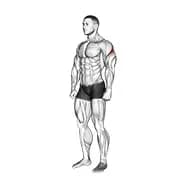 rear deltoid stretch2× 30 s per side
Arm straight across the chest, pull on the upper arm — never on the elbow joint. Keep the shoulder down or the pull migrates into your neck.
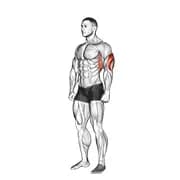 overhead triceps stretch2× 30 s per side
Elbow points at the ceiling, hand walks down between the shoulder blades. Keep the ribs down — otherwise the pelvis tips and you stretch your back, not the triceps.
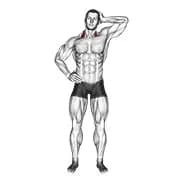 side push neck stretch1× 30 s per side
Ear toward the shoulder, the hand adds only the weight of the head — never pull. The opposite shoulder stays down.
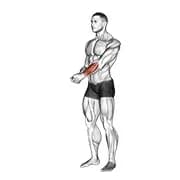 side wrist pull stretch1× 30 s per side
Arm straight, palm down, gently pull the fingers toward you, then turn the palm over and stretch the other side. After pulling and curling days this keeps the grip fresh.
Static stretching belongs AFTER the session, never before it — held before a heavy set it measurably costs force output. Move into each position until you feel mild tension, never pain, and breathe out into it. Hold still: no bouncing on a fatigued muscle. Skip a muscle that is cramping and walk it off first.
Day 32× / week
Legs
Quads · Hamstrings · Glutes · Calves · Core
7
Exercises
24
Sets
~80
min
Warm-up~10 minLifting~62 minCool-down & stretching~8 minQuads8Hamstrings7Glutes3Calves3Core3
Coach's note
Squat heavy, then unilateral and hinge work for hamstrings and glutes, a strict leg curl, calves to finish.
Time-saver
This day is built around focused quality volume — supersets here would make the sets compete. Short on time: trim rest on everything except the primary lift by 15–30 s (saves ~6 min) and keep the primary's full rest untouched.
Second session this week
Second run (Sat): front squat → hack squat or leg press, straight-leg deadlift → seated leg curl. Knees and hips share the second week's load differently — that's the point.
%1RM77–82%RPE6 · 4 RIRTempo3-1-1Rest2–3 minmin~13
Jun42.5 kgInt75 kgAdv112.5 kg
Bar in the front rack on the upper chest, elbows high — brace, sit between the hips, knees track over toes, drive up.
Machine taken or not in your gym?
Warm-up sets
15 × 37.5 kg8 × 57.5 kg
Step by step
- Start by standing with your feet shoulder-width apart and the barbell resting on your upper chest, just below your collarbone.
- Hold the barbell with an overhand grip, keeping your elbows up and your upper arms parallel to the ground.
- Lower your body down into a squat position by bending at the knees and hips, keeping your back straight and your chest up.
- Pause for a moment at the bottom of the squat, then push through your heels to return to the starting position.
- Repeat for the desired number of repetitions.
%1RM73–78%RPE6 · 4 RIRTempo3-0-1Rest90–120 smin~10
Jun9 kgInt17.5 kgAdv25 kg
Per dumbbell. Long stride, back knee toward the floor, push the heel.
Machine taken or not in your gym?
Warm-up sets
15 × 8 kg8 × 14 kg
Step by step
- Stand with your feet shoulder-width apart, holding a dumbbell in each hand.
- Take a step forward with one foot and position your feet so that your front foot is flat on the ground and your back foot is elevated on a bench or step.
- Lower your body by bending your front knee and hip, keeping your back knee slightly bent and your back heel off the ground.
- Continue lowering until your front thigh is parallel to the ground, then push through your front heel to return to the starting position.
- Repeat for the desired number of repetitions, then switch legs and repeat.
%1RM73–78%RPE6 · 4 RIRTempo3-0-1Rest90–120 smin~10
Jun45 kgInt75 kgAdv110 kg
Soft knees, hips back, feel the hamstring stretch, bar close to legs.
Machine taken or not in your gym?
Warm-up sets
15 × 37.5 kg8 × 57.5 kg
Step by step
- Stand with your feet shoulder-width apart and your toes pointing forward.
- Hold the barbell with an overhand grip, hands slightly wider than shoulder-width apart.
- Bend at your hips and lower the barbell towards the ground, keeping your back straight and your knees slightly bent.
- Lower the barbell until you feel a stretch in your hamstrings.
- Engage your hamstrings and glutes to lift the barbell back up to the starting position.
- Repeat for the desired number of repetitions.
%1RM73–78%RPE6 · 4 RIRTempo3-0-1Rest90–120 smin~8
Jun30 kgInt45 kgAdv60 kg
Machine stack. Hips pinned down, squeeze at full bend, 3 s lowering.
Machine taken or not in your gym?
Warm-up sets
12 × 27.5 kg
Step by step
- Adjust the machine to fit your body and select the desired weight.
- Lie face down on the machine with your legs straight and your heels against the padded lever.
- Grasp the handles or the sides of the machine for stability.
- Keeping your upper body stationary, exhale and curl your legs up as far as possible without lifting your hips off the pad.
- Hold the contracted position for a brief pause as you squeeze your hamstrings.
- Inhale and slowly lower the lever back to the starting position.
- Repeat for the desired number of repetitions.
%1RM63–68%RPE6 · 4 RIRTempo2-0-1Rest60 smin~6
Jun27.5 kgInt47.5 kgAdv67.5 kg
Cable stack. Face away, hinge, let the rope pull the hips back — snap to a full lockout and squeeze the glutes.
Machine taken or not in your gym?
Warm-up sets
15 × 25 kg8 × 35 kg
Step by step
- Stand facing away from the cable machine with your feet shoulder-width apart.
- Grab the rope attachment with both hands and step forward, creating tension in the cable.
- Bend at the hips and lower your upper body until it is parallel to the ground, keeping your back straight.
- Engage your glutes and hamstrings to pull your body back up to the starting position.
- Repeat for the desired number of repetitions.
%1RM63–68%RPE6 · 4 RIRTempo2-1-1Rest60 smin~7
Jun40 kgInt72.5 kgAdv105 kg
Full stretch at the bottom, 1 s squeeze at the top — no bouncing.
Machine taken or not in your gym?
Warm-up sets
12 × 42.5 kg
Step by step
- Adjust the seat of the leg press machine so that your knees are slightly bent when your feet are on the footplate.
- Sit on the machine with your back against the backrest and your feet flat on the footplate, shoulder-width apart.
- Place your toes and the balls of your feet on the footplate, keeping your heels off the edge.
- Release the safety handles and push the footplate away from you by extending your knees.
- Once your knees are fully extended, slowly lower your heels by flexing your calves.
- Pause for a moment at the bottom, then push the footplate back up by extending your calves.
- Repeat for the desired number of repetitions.
%1RM—RPE6 · 4 RIRTempo2-0-1Rest45–60 smin~6
JunBodyweightIntBodyweightAdvBodyweight
Bodyweight. Roll up one vertebra at a time, lower under control, chin off the chest.
Machine taken or not in your gym?
Step by step
- Lie on a decline bench with your feet secured and your knees bent.
- Place your hands behind your head or across your chest.
- Engage your abs and lift your upper body off the bench, curling forward towards your knees.
- Pause for a moment at the top, then slowly lower your upper body back down to the starting position.
- Repeat for the desired number of repetitions.
Cool-down & stretching
~8 minLeg day order that works: hip flexor, quads, hamstrings, glutes, calves. Never stretch a cramping muscle — walk a minute first, then start.
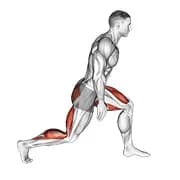 world's greatest stretch2× 30 s per side
Deep lunge, drive the back hip forward, tuck the pelvis. Short hip flexors tilt your pelvis into every squat that follows — this is the priority after squatting and leg pressing.
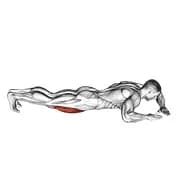 lying (side) quads stretch1× 30 s per side
Lying on your side, grab the top foot, heel to the glute, push the hip slightly forward. Keep knee beside knee — don't let it flare out.
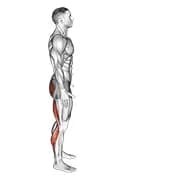 runners stretch2× 30 s per side
Front heel down, toes up, hinge forward from the hip with a flat back. A rounded back stretches nerve, not muscle.
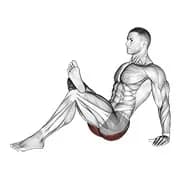 seated glute stretch1× 30 s per side
Ankle over the opposite knee, chest pushed forward and tall. The moment the back rounds you are stretching the back, not the glute.
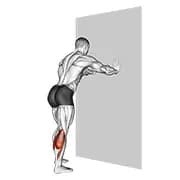 calf stretch with hands against wall1× 30 s per side
Back leg straight, heel down, drive the hip toward the wall. This targets the gastrocnemius — the heel never leaves the ground.
Static stretching belongs AFTER the session, never before it — held before a heavy set it measurably costs force output. Move into each position until you feel mild tension, never pain, and breathe out into it. Hold still: no bouncing on a fatigued muscle. Skip a muscle that is cramping and walk it off first.
For the trainer
Coaching standards
- 01
Technique before load — full range, controlled 2–3 s eccentric, no momentum.
- 02
Progressive overload — log every set and beat last week's reps or weight.
- 03
Proximity to failure — compounds at 1–2 RIR, isolation at 0–1 RIR.
- 04
Volume landmarks — build toward 10–20 weekly hard sets for the muscles the split emphasizes, counting the compound work that hits them on the way.
- 05
Recovery is training — 7–9 h sleep, 1.6–2.2 g protein/kg bodyweight, 48 h per region.
For the trainer
Avoid these mistakes
Ego-lifting and half reps — load that buries technique builds nothing.
Jumping the weight in big steps instead of small, repeatable increments.
Skipping the warm-up ramp — cold heavy sets are where joints get hurt.
Programme-hopping every week — you can't measure progress you keep resetting.